 EN
EN
An effective Fiber-to-the-Home (FTTH) deployment can only take place if the right selection of FTTH devices cooperate seamlessly to offer ultrafast broadband services to subscribers. Each piece of fiber optic equipment is pivotal in delivering dependable and secure high-speed Internet services from the customer's side to the headend. The following is a list of typical FTTH devices, and the key optical and PON equipment, commonly used in a comprehensive FTTH network.
Optical Line Terminal (OLT): The Network Core
The OLT is the main access point in an FTTH deployment. Located at the Internet Service Provider (ISP) central office (CO) or data center, the OLT connects to each ONT in the passive optical network to control and direct customer traffic up and down the network. Modern OLTs use various standards, such as GPON, XGS-PON, and NG-PON2, providing scalable bandwidth, high port densities, and intelligent bandwidth and traffic management. The performance parameters of OLT equipment, such as port density, maximum splits, and support for different PON standards, largely determine the capacity and scalability of the entire FTTH network. Shandong Wanshuo Optoelectronic Equipment Co., Ltd. provides a complete line of GPON OLTs, which seamlessly connect with other fiber optics solutions to maximize capacity and performance of FTTH networks.
Optical Splitters: Passive Distribution Nodes
Optical splitters are the most basic passive FTTH devices that are used to split the power of the optical signal and distribute a single optical signal from the upstream to multiple downstream output ports. Typically, a single feeder fiber is split into multiple end-user fibers using a splitting ratio of 1:8, 1:16, 1:32, or 1:64. Planar Lightwave Circuit (PLC) splitters are widely used in today's networks as they are less sensitive to changes of light polarization and temperature. Splitters are usually packaged and installed in a Fiber Distribution Hub (FDH), Field Optical Network Terminal (FNT), or rack mount unit and are not self-powered or hooked-up to external power.
Optical Network Terminal (ONT): The Subscriber Gateway
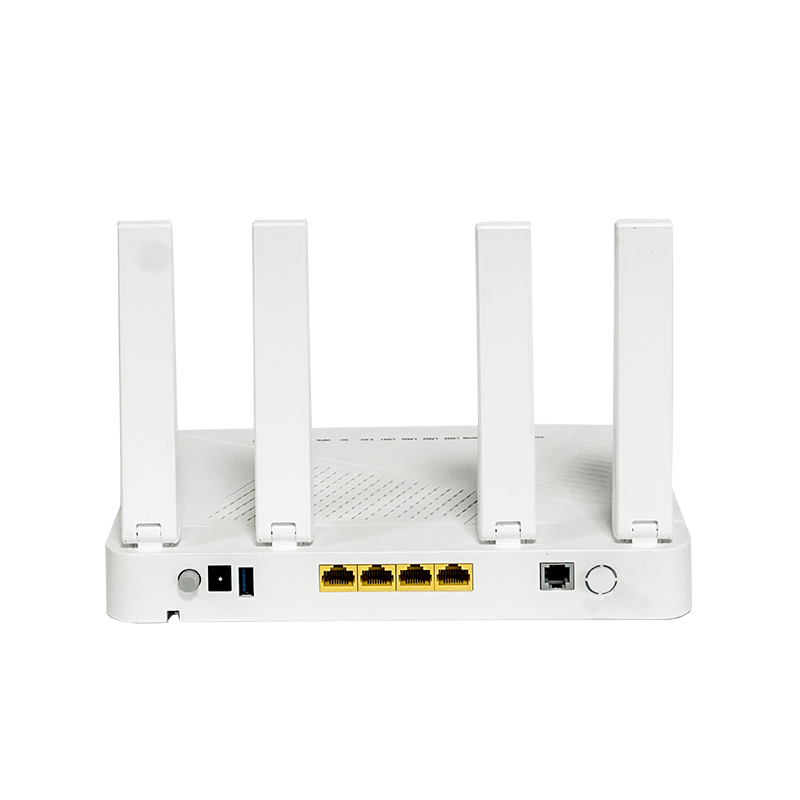
The ONTs are located at the subscriber's premises and are used to convert the downstream optical signals from the ISP into electrical signals for customer devices for data, voice and video services. A number of today's ONT devices include gigabit Ethernet and Wi-Fi ports. They can in addition feature Wi-Fi capabilities (WiFi4, WiFi5 and WiFi6), digital voice connectivity, RF output ports for Cable TV service and support for smart home features. The selection of ONT will depend on bandwidth, type of services (data, triple play), connectivity and Wi-Fi standard. Shandong Wanshuo Optoelectronic Equipment Co., Ltd. supplies a complete lineup of ONUs to satisfy various customer needs such as 1GE ONU, CATV ONU, Wi-Fi dual-band ONU etc.
Optical Receiver: The Final Link
Optical receiver (also called photodetector) is a type of optical receiver that is used to convert optical signal (usually brought by optical network) to electrical signal for amplification or for other processed information. CATV optical receivers often include an optical-to-RF conversion and automatic gain control (AGC) to ensure that the output signal level is substantially constant over varying input level, and may be capable of receiving and transmitting both analog (AM) and digital video simultaneously. WDM (wavelength division multiplexing) capable optical receivers reduce the count of optical fibers used in FTTB applications and the use of integrated EDFA in the optical Node will give an improved CNR.
Shandong Wanshuo Optoelectronic Equipment Co., Ltd. provides high quality fiber optic receivers, and products are produced by innovative R&D, strict quality control during mass production and leading edge technology, to ensure that the optical network equipment has stable product quality and performance.
Supporting Equipment: Amplifiers and Transmitters
An optical transmitter is an important part of FTTH system, which is used to send modulated optical signals into optical fiber. It modulates optical signals at different wavelengths to convey electrical signals over the network. In larger deployments, fiber amplifiers can be employed to amplify optical signals and increase their power level, allowing for further reach and adequate signal strength at the customer location. Fiber amplifiers are also referred to as optical amplifiers, optical gain media, optical amplifier media, and fiber gain media.
Manufacturing Excellence Behind FTTH Equipment
Shandong Wanshuo Optoelectronic Equipment Co., Ltd. has over 20 years in the development and production of the most advanced FTTH devices. The company's 3D SPI+3D AOI full process testing system, automated wave soldering, automated assembly and automated device production systems guarantee high quality and traceable FTTH products using world-leading SMT production lines, with a direct connection rate of 99.8%.
From raw material to finished products, full traceability is ensured. Shandong Wanshuo has fully covered optical device production lines, and can provide any FTTH optical network device required by all the operators with growing FTTH applications.
Conclusion
Designing a cost effective, dependable and future-proof FTTH network that offers ultra-high-speed broadband services is essential to select the right combination of FTTH devices, which together make up a complete and effective FTTH equipment solution from the OLT, splitter to ONT and optical receiver. Shandong Wanshuo Optoelectronic Equipment Co., Ltd. is a company that is committed to intelligent manufacturing, and has a broad range of strong PON equipment and optical network equipment. It is an industry leader and trusted partner in making a fiber-connected world possible.