 EN
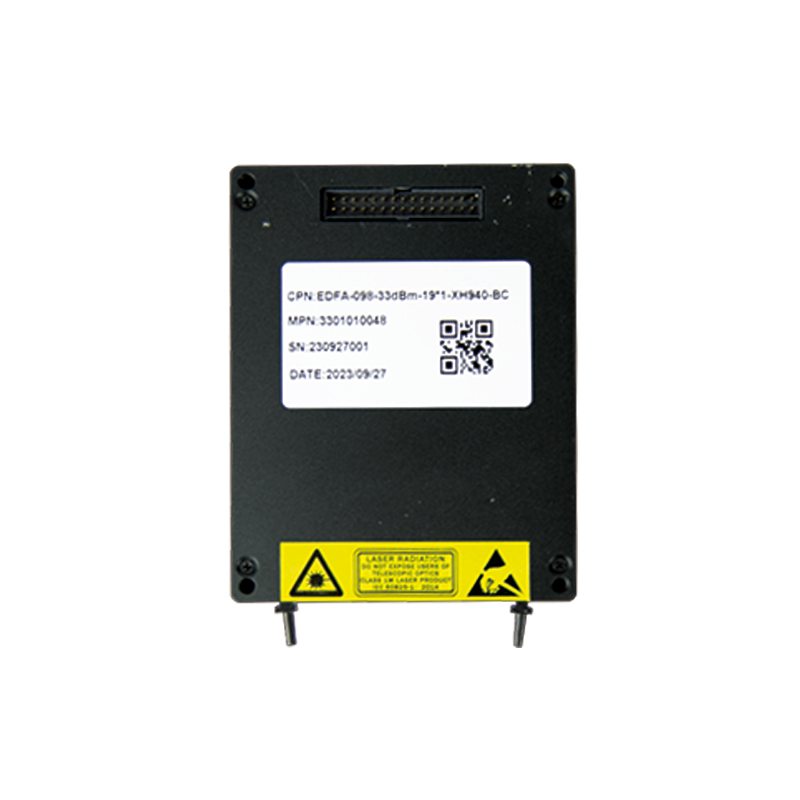
With fiber-to-the-home (FTTH) networks developing to deliver bandwidth hungry applications such as 8K video streaming, cloud gaming and enterprise connectivity, demand for high-power optical amplification is greater than ever. When designing network or system integration, network engineers and system integrators often have to make a choice between two types of fiber amplifiers: EDFA (Erbium-Doped Fiber Amplifier) and its more powerful counterpart, EYDFA (Erbium-Ytterbium-Doped Fiber Amplifier). This article provides thorough technical comparison to make the choice between these amplifier technologies easier for you to determine which one is most suitable for your high-power FTTH deployment.
The Technical Foundation: What Sets EYDFA Apart from EDFA?
Both EDFA and EYDFA seem to be the same and both use erbium ions as a gain medium to amplify optical signals in the C-Band (1530-1565 nm). But the physics is another matter. In the traditional EDFA, single mode core pumping is used, where the pump light (usually at 980 nm or 1480 nm) is confined to the core of the fiber. The design naturally results in low pump power absorption and output power from the cells is bounded by about 23 dBm (200 mW/cell) per channel because of the nonlinear behavior of the cells and the power limits of the pump diodes.
EYDFA, on the other hand, brings forth dual-clad fiber structure that is doped with erbium and ytterbium. The ytterbium ions (Yb³+) are sensitizers that are very effective in absorbing the multi-mode pump beam in the 915–980 nm spectral range and transfer the energy to the erbium ions by the resonant energy transfer process. EYDFA offers output power in excess of 1 watt with commercial modules, up to 27–35 dBm (0.5–3 W), and even up to 41 dBm (12 W) in rack-mount configurations, thanks to the combination of this double clad design and large mode area core. The EYDFA is an ideal amplifier for high power optical amplifier applications because of its excellent characteristic of overcoming the pump absorption saturation effect of conventional EDFA.
Performance Comparison: Power, Gain, and Noise Figure
Among the above parameters, output power is the most important one when comparing the EDFA and EYDFA for FTTH. A standard EDFA provides 13-23 dBm per output port and is suitable for 1:64 split ratios for medium distance (10-20 km) propagation. But with 1:128 or 1:256 passive splits to high-density urban living compounds, the optical budget of an EDFA may not be sufficient. There is an EYDFA amplifier, however, that delivers 27-33 dBm per port, which is equivalent to quadrupling the available power without using mid-span active regeneration.
Another important factor to consider is gain flatness. The EYDFA exhibits good gain uniformity over the total C-band (from 1530 nm to 1565 nm) with optimized co-doping ratios and pump distribution. For WDM (Wavelength-Division Multiplexing) overlay systems in FTTH, the flatness is especially desirable because the signal coming from WDM systems must be amplified to consistent level to maintain quality in the overlay signals (such as CATV 1550 nm and RF overlay at 1578 nm).
Application Scenarios: Where Does Each Amplifier Shine?
The choice between EYDFA and EDFA ultimately depends on the deployment context. In the typical FTTH application where the split ratio is 1:32 or 1:64 and feeder length is less than 20 km, the use of a conventional EDFA is the most economical option. It provides proven reliability, small 1U or 2U form factors and stable supply chains.
For high-powered FTTH networks, especially those focused on large scale CATV distribution, however, the EYDFA becomes the best option, when compared to RFoG (RF over Glass) rural broadband or triple play convergence. Now imagine that you have one optical line terminal (OLT) connected to four 1:256 splitter cascades, each with 1,024 subscribers. Thus, the topology can be driven by a single EYDFA amplifier with 33 dBm output, which is very convenient for network configuration and greatly decreases the number of fault points. Likewise, for longer feeder lengths to cluster units (30-40 km), the EYDFA can deliver the additional power budget to compensate for attenuation and splitter loss without the cost of a remote amplifier hut.
In addition, the EYDFA provides benefits in burst mode amplification and transient suppression for use in high-power optical amplifier solutions in data center interconnects and sensing systems, outperforming conventional EDFA designs.
Cost-Benefit Analysis: Total System Economics
The total system economics may favor the high power option of an EYDFA amplifier, compared to an EDFA of similar performance. In distributed amplification architectures, single EYDFA replaces 4 to 8 cascaded EDFA units. This consolidation saves costs on equipment purchase, rack space, power and maintenance. Moreover, the simplified signal chain reduces cumulative noise figure degradation, which can be 0.5-1 dB per cascaded EDFA stage.
In addition, the pump laser of EYDFA has higher reliability. EYDFA modules are widely available to use low cost, high power multi-mode pump diodes, rather than expensive single-mode pump lasers, providing higher mean time between failures (MTBF) and lower replacement cost over the 10-year typical network life cycle.
Why Choose Shandong Wanshuo Optoelectronic Equipment Co., Ltd.?
Shandong Wanshuo Optoelectronic Equipment Co., Ltd. has extensive experience in the field of fiber amplifier products, offering trusted EDFA and EYDFA solutions. The company's 77FEYA2 Series 2U high-power EYDFA amplifier harnesses advanced erbium-ytterbium co-doped double-clad fiber technology, delivering total output up to 41 dBm (over 12 W) with flexible 4-, 8-, 16-, 32-, and 64-port configurations to match diverse network topologies. Intelligent gain control, full alarm monitoring and hot-swappable redundant power supplies to ensure 24/7 continuous operation.
Product excellence is guaranteed by the manufacturing power of Shandong Wanshuo. The company operates 12 high-grade purification workshops, achieves a 99.8% first-pass yield in SMT production, and employs fully automated AOI-inspected wave soldering. The company's independent R&D team has been developing and delivering intelligent testing systems with full process data traceability, which have produced high power optical amplifier solutions that are compliant with the CE, FCC and RoHS certifications. Shandong Wanshuo Optoelectronic Equipment Co.,Ltd. offers the technology and production capacity, from pilot projects to nationwide deployment, to every network operator seeking the best power, performance balance and reliability and cost-efficiency in their FTTH deployments.