 EN
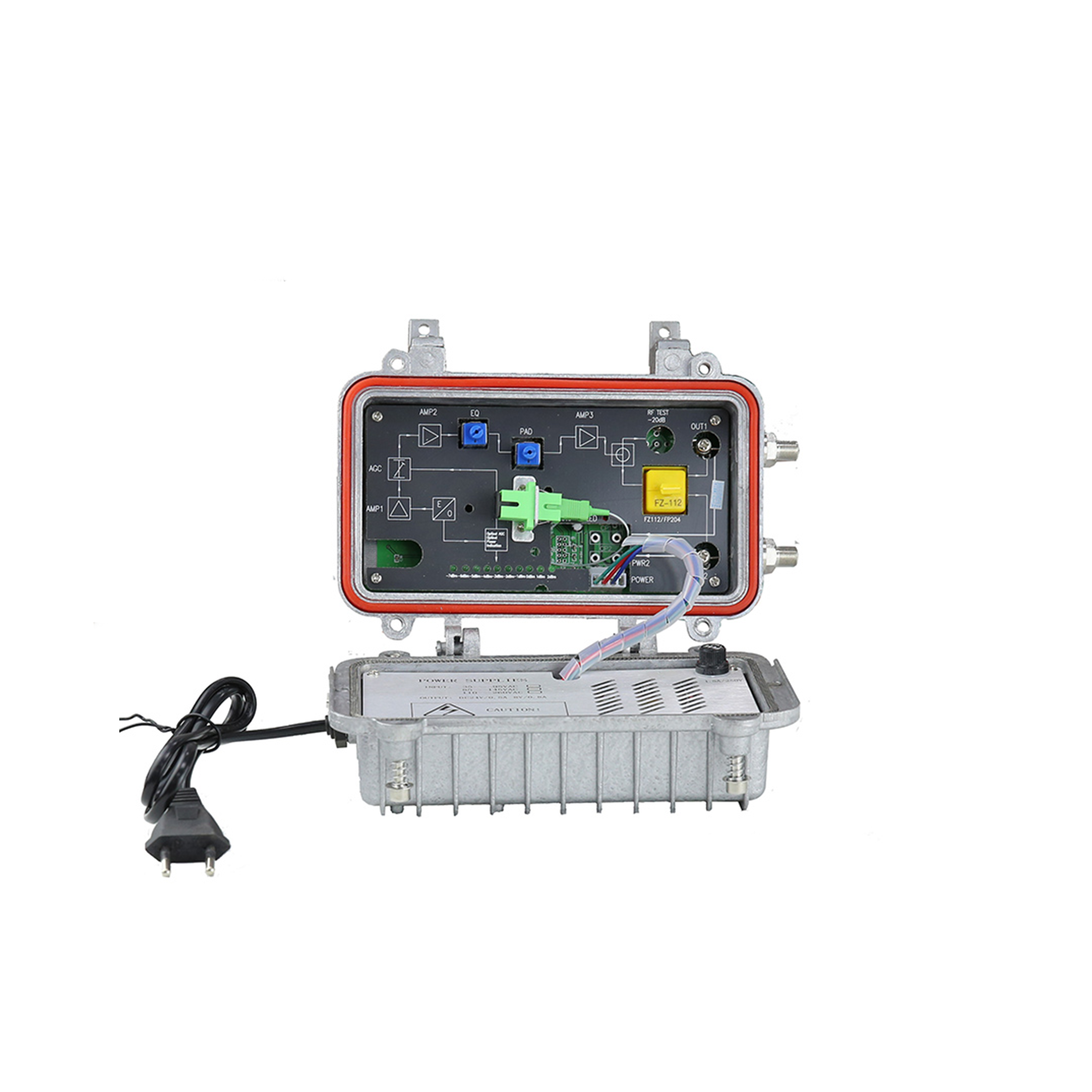
Erbium-doped fiber amplifiers (EDFAs) are the cornerstone of present-day optical communication networks that provide direct optical amplification without the need for expensive electro-optical conversion. The gain characteristic of an EDFA is crucial for network designers and system integrators to design reliable and high-performance optical networks. This article breaks down the three critical dimensions of EDFA gain, small-signal gain, saturation, and gain-flatness of an EDFA and their effects on real-world applications such as CATV, PON, optical sensing, and more.
Small-Signal Gain: The Foundation of Amplifier Performance
The simplest definition of EDFA gain is the ratio of the power of the output signal to the power of the input signal. The amplifier is said to be in the small signal regime when the signal optical power (SOP) is below a few microwatts. The gain in this area is mostly independent from the power level of the pump laser and is just a function of the length of the erbium doped fiber and the pump laser power.
The small-signal gain is the maximum amplification possible from the EDFA, before the output starts to be compressed due to the saturation effect. High small-signal gain (typically at least 30 dB) is important in pre-amplifier applications for long-distance networks to amplify low-level signals to a level above the noise level of subsequent amplifiers. For CATV and PON applications, where input signal levels can vary widely, stable small-signal gain provides uniform service quality to subscribers across a range of distances.
Saturation Output Power: When the Amplifier Reaches Its Limit
When the input signal power is increased, the EDFA will eventually enter saturation mode from small-signal mode of operation. This is because the erbium ions are being pumped to emit a photon at a rate that exceeds the rate at which the pump laser can pump them. This means that once the power level exceeds a certain point, additional increases in input power provide less of an increase in output power.
Saturated output power is the optical power that the EDFA can provide at an acceptable level of signal integrity. A high saturated output power (typically +20 dBm to +30 dBm or greater) is required for booster amplifiers at the CATV headend or long-haul transmitter to power signals through additional passive optical components such as splitters and fiber spans. This limit helps engineers to design networks that run well below the limit, without the risk of signal distortion or inter-channel crosstalk that can impair network performance in WDM systems.
EDFA Gain Flatness: Consistency Across Wavelengths
The emission spectrum of erbium is not necessarily even. An EDFA has an inherent gain peak at about 1532 nm and gain that rolls off toward the edges of the C-band without correction. The EDFA gain flatness is used to measure the evenness of the response of the EDFA across different wavelengths in the EDFA's operating band, particularly important for WDM systems, where several channels should be at near-equal power levels when they reach the receiver.
If the gain is not flat, the optical signal-to-noise ratio (OSNR) after cascaded amplifiers is penalized and receiver errors are possible. Gain-flattening filters (GFFs) are usually used inside the EDFA to achieve a flat spectrum response with a ±1 dB or better flatness over the C-band. Excellent gain flatness is important for multi-channel CATV and DWDM PON architectures to provide equal treatment of each wavelength channel, which helps in setting the operational margins and network design.
How Shandong Wanshuo Delivers Reliable EDFA Performance
Theory is good, but practical consistency is better for us, at Shandong Wanshuo Optoelectronic Equipment Co., Ltd. Our EDFA and EYDFA production lines have full-process automated testing integrated with data traceability, ensuring that all units are shipped with gains that match the rated values, saturated output power conditions and gain flatness specifications.
From raw material to finished devices, our dust-free workshops and self-controlled production lines ensure environmental and process stability for high-performance optoelectronic products. For customized solutions with optimal gain and output power, contact our engineering team for optical transmitters, fiber amplifiers or full CATV and PON solutions.