 EN
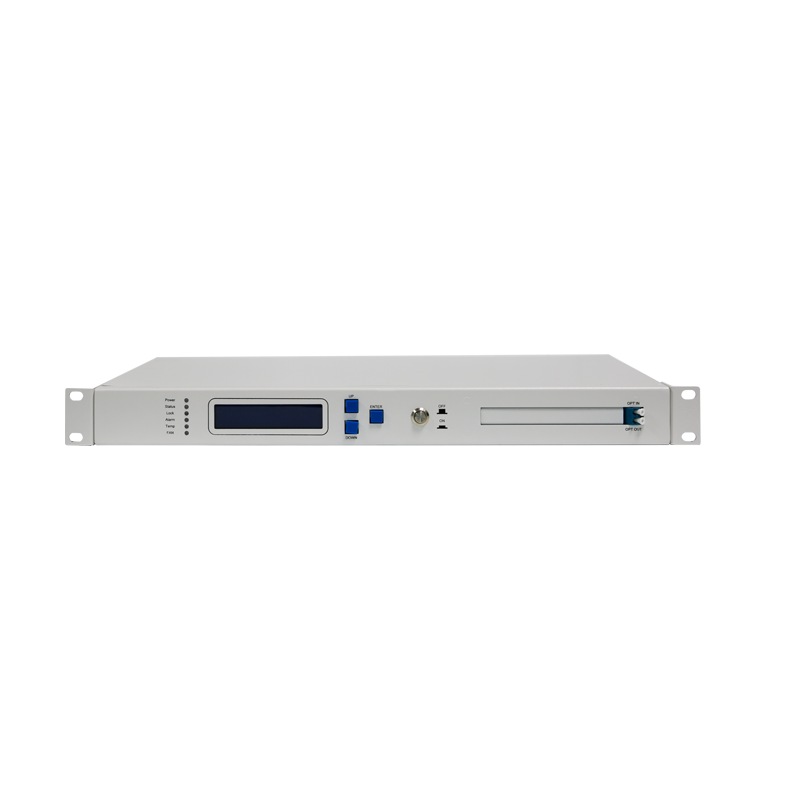
When the fiber-to-the-home (FTTH) network is expanded to thousands of subscribers covering large geographical areas, it is imperative to choose the right optical amplification solution. The selection of a high power EDFA can significantly affect signal quality, network reach, and overall cost of ownership. This guide offers a hands-on guide for network engineers and system integrators considering high power amplification in a large-scale FTTH implementation.
Understanding the EDFA vs. EYDFA Distinction
The first step in choosing a high-power optical amplifier is to understand the difference between standard EDFA technology and an EYDFA technology. It is based on a single-cladding erbium-doped fiber using a pump laser with a wavelength of 980 nm to generate 13–23 dBm per output port on a 16- or 32-port chassis, ideal for a standard greenfield FTTH application with moderate reach.
For the case of large-scale deployment with more than a few watts of output (more than 10 W) EYDFA (Erbium-Ytterbium co-Doped Fiber Amplifier) uses ytterbium co-doping with a dual clad pump structure, with 27–33 dBm total output in a single stage. This technology is particularly applicable for configurations where there are 32, 64 or 128 output ports required on a single amplifier shelf or feeder distances are greater than 20–40 km. Shandong Wanshuo Optoelectronic Equipment Co., Ltd. has already been able to design and produce 10 W polarization maintaining Er-Yb co-doped fiber amplifier modules successfully, indicating that the company has the manufacturing capacity to meet the requirements of such demanding applications.
Critical Performance Specifications to Evaluate
There are some important parameters to consider when evaluating high power EDFA products. The "noise figure" (NF) represents signal degradation; the lower the noise figure, the better the signal quality. The desired NF for high performance EDFAs is in the range of 4.0 dB to 5.5 dB, and a 1 dB decrease can extend the transmission range by 10–20%. The channel power balance of multi-channel systems should be maintained within ±0.5 dB to ±1.5 dB across the C-band (1530–1565 nm).
A stable output power under different input condition is also required for FTTH EDFA solutions. Find amplifiers with APC (Automatic Power Control), ACC (Automatic Current Control), and AGC (Automatic Gain Control) modes so that you can achieve accurate stabilization. These control modes are especially significant for the deployment of multi port EDFA configurations to cater for different subscriber densities.
The Role of XGS-PON Compatibility and Pass-Through
The emergence of XGS-PON data services has enabled modern FTTH networks to combine broadcast video overlay with data services. This is particularly important to consider when choosing a high-power amplifier for pass-through XGS-PON, which is the ability to physically pass the PON wavelengths (1270 nm, 1490 nm, 1577 nm) through the amplifier shelf and simply boost the 1550 nm broadcast signal.
The solution calls for a combiner with high performance, supporting both COM and PON ports and CATV. Among key specifications are the limit of insertion loss on the PON path of ≤ 1 dB, the isolation of >30 dB between the OLT receiver and 1550 nm power to reduce the risk of receiving a return signal, and return loss of >45 dB to limit Rayleigh back-scatter. Being able to overlay CATV amplification and PON on the same feeder fiber is a major cost savings over an overlay cable solution in terms of CAPEX.
Evaluating Manufacturing Capability and Supply Stability
Technical specification is not enough, it is the manufacturer's production environment and quality system that determine long-term reliability. With the strict requirements of optoelectronic product manufacturing, Shandong Wanshuo Optoelectronic Equipment Co., Ltd. has a modern 7,500 m² production facility with 12 sets of high-grade purification and dust-free workshops are set up. The company has launched full-process automatic production lines, such as high-speed SMT chip mounting machine with 3D SPI+3D AOI direct connection rate of 99.8% and no-lead wave soldering production lines.
With their control of the entire production process, from raw materials to finished products, manufacturers can guarantee that each batch is consistent and performs identically. The production capacity is more than 3,000 fiber amplifiers per month, and the technical teams have a large number of high-caliber people, which can ensure that large FTTH projects are delivered in a stable manner by established manufacturers.
Total Cost of Ownership and Future-Proofing
When choosing a high-power optical amplifier, considering only the unit price is not enough—you must evaluate the total cost of ownership. Take into account future network expansion options, port count expansion, 25G/50G PON evolution, and remote management of the amplifier via SNMP and web interfaces. Multi port EDFA configuration offers flexible output (8 x 22 dBm, 16 x 20 dBm, or 32 x 19 dBm) to match the capacity with the subscriber density, and reduce power consumption.
Long-term costs also take into account environmental ruggedness. The key is to find amplifiers that can be used in wide operating temperature ranges (-5°C to 65°C), that have redundant power supplies, and that have overload protection to allow for 24/7 stability in various deployment scenarios. Built-in back-reflection measurement, web-based monitoring and optical input switching capabilities offer operational visibility, minimizing the time spent on troubleshooting and maintenance throughout the system's lifespan.
Conclusion
When selecting a high power EDFA for large FTTH deployments, a combination of technical performance, compatibility with PON architectures, manufacturing quality and operational considerations must be taken into account. When there is a need to support ultra-high output power for several ports and XGS-PON coexistence, EYDFA technology is the most powerful solution. Collaborate with manufacturers that have a track record of supply of stable products with automated quality control systems and proven production facilities for demanding carrier grade applications. For example, Shandong Wanshuo Optoelectronic Equipment Co., Ltd. has vertically integrated production lines; the 10 W EYDFA module development is the evidence of mature high-power amplifier manufacturing skills.