 EN
EN
In a world ever more dependent on the benefits and conveniences offered by ultra-fast broadband, the fact remains Fiber-to-the-Home (FTTH) is the proven path that enables full fiber up to our doors, storefronts and workplaces. What exactly is fiber to the home? How are FTTH networks establishing new industry standards, and what components make fiber transmission technology possible? Keep reading to find out more about network architecture, core FTTH components and of all important information to help FTTH bring huge advantages.
Understanding FTTH Network Architecture
A typical FTTH network architecture will utilize a Passive Optical Network (PON). What this essentially means is there are fewer active electronic components located between the central office and your home or business, thus greatly improving network reliability and minimizing maintenance costs. There are two commonly implemented FTTH architectures: centralized split architecture, and cascaded star architecture.
In a centralized split architecture, all optical splitters are located in one single fiber distribution hub. A fiber distribution hub usually houses a single 1:32 or 1:64 splitter that connects all of the devices in a hub directly to the central office Optical Line Terminal (OLT). This makes troubleshooting the network quite easy and is generally best suited to dense urban environments.
However, a cascaded star architecture utilizes several splitting stages. With this FTTH architecture, the requirements for the initial fiber trunk are minimized. This is ideal for any of the suburban or rural environments where fewer lines are likely to be necessary, and it makes scaling your network more cost-effective.
Key FTTH Components
In a well-functioning FTTH network, there are a few essential FTTH components that all play a crucial role:
Optical Line Terminal (OLT): The OLT is located at the service provider's central office and functions primarily to manage traffic flow. It allocates the needed bandwidth among all of the connected subscribers.
Optical Network Terminal (ONT): Located at the consumer's home, the ONT converts optical signal and converts it into an electrical signal for your router or set-top box to use.
Optical Splitters: As mentioned before, these devices are a key part of the PON architecture. They break a single optical signal into multiple output signals, allowing for numerous customers on a single run of fiber optic cable.
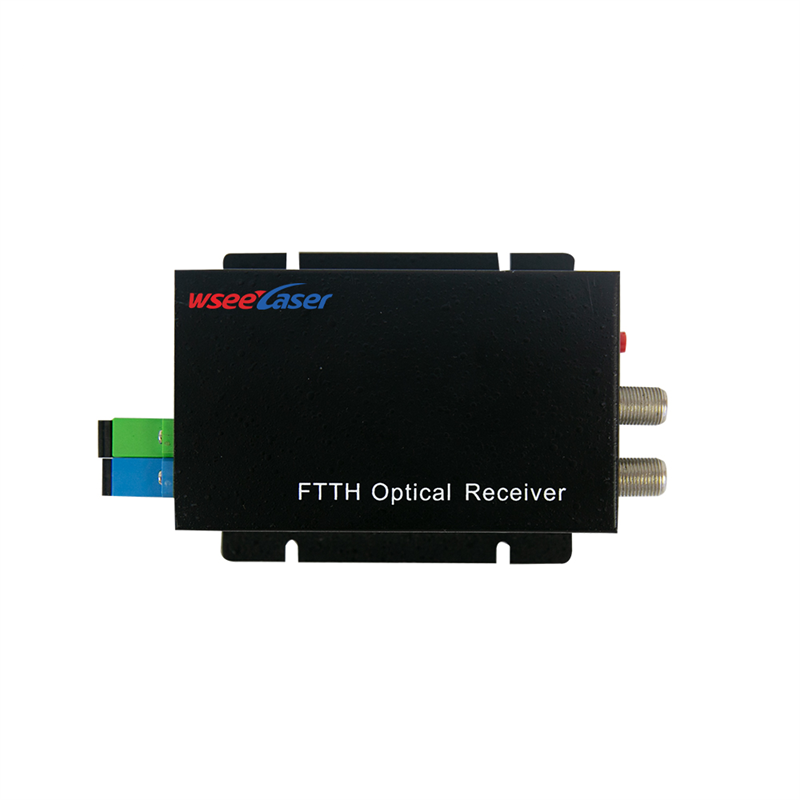
Optical Receivers: Optical receivers in FTTH systems are essential because they take the incoming signal at your home and convert the received light back into an electrical signal with minimal noise and optimal sensitivity. This ensures clear transmission of internet, voice, and CATV traffic over fiber optic cable and this component is something Shandong Wanshuo Optoelectronic Equipment Co., Ltd. takes pride in producing. Our optical receivers have excellent Automatic Gain Control (AGC), WDM integration to transmit both analog and digital signals, and operate over a broad frequency range to provide stable transmission of all data.
Benefits of FTTH Deployment
FTTH goes well beyond the realm of offering faster internet speeds:
Unmatched Bandwidth: FTTH supports symmetric gigabit speeds and will support 4K/8K streaming, cloud, online gaming, etc. without causing any delays or buffers.
Superior Reliability: Fiber optic cables are not be affected by lightning strikes, electromagnetic signals, or signal degradation over distance like copper wires.
Future-Proof Infrastructure: FTTH is a truly future-proof infrastructure that will support technologies like 5G backhaul, IoT, smart city applications, etc.
Lower Total Cost of Ownership: Because they don't include any active components, these PON systems require less maintenance and have lower energy consumption than other solutions.
Manufacturing Excellence Behind FTTH Components
Shandong Wanshuo Optoelectronic Equipment Co., Ltd. utilizes state-of-the-art SMT production lines, with high-speed chip mounters of industry-leading standards and 3D SPI+3D AOI testing equipment to ensure a 99.8% direct placement rate of the components in our manufactured optical receivers and other FTTH components. We have wave soldering lines that utilize the newest lead-free technologies and automated production lines that guarantee end-to-end traceability of our devices, providing our clients worldwide with whole link one-stop solutions for their fiber to the home deployments.
Conclusion
Ultimately, FTTH is no less than top best option for any and all type of Broadband connectivity. Knowledge regarding FTTH architecture and importance of diverse FTTH parts such as OLTs, Splitters, optical receivers, in efficient and fruitful networking implantation is no doubt of high priority. Shandong Wanshuo Optoelectronic Equipment Co., Ltd. is proud to be a reliable partner in the optical communication industry and we strive to create increasingly advanced fiber to the home devices with our independent research and development and intelligent manufacturing.