 EN
EN
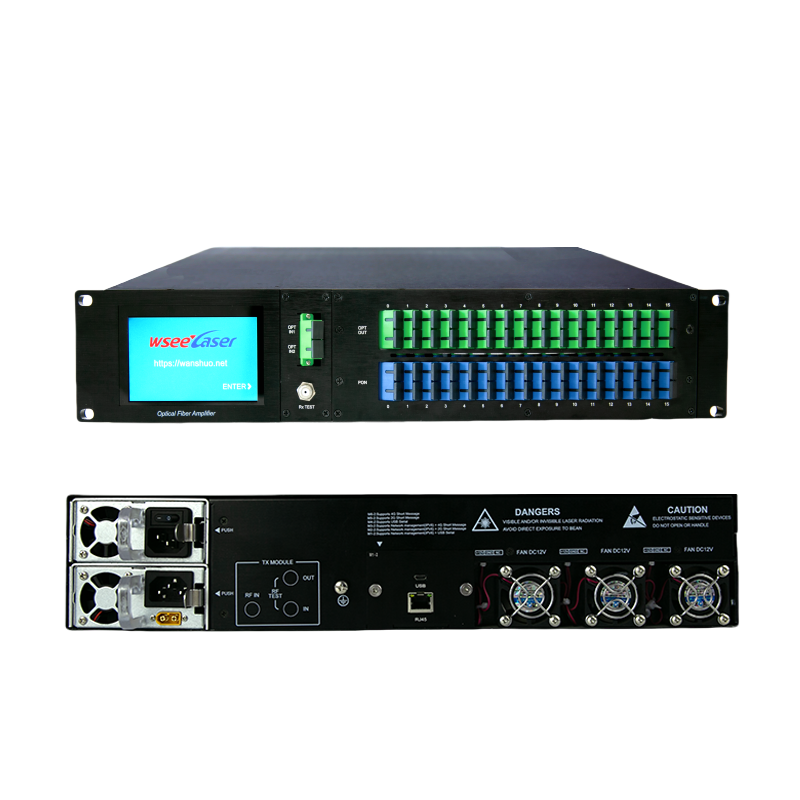
Long-distance signal transmission in traditional fiber networks has always been a challenge. The Erbium-Doped Fiber Amplifier (EDFA), as the heart of optical networks, has been invented as an ideal solution to all-optical amplifier, allowing signal to be transmitted throughout the fiber without expensive optical-electrical-optical conversion. Our company, Shandong Wanshuo Optoelectronic Equipment Co., Ltd., has provided professional end-to-end, one-stop solutions in the optical communication industry, including high performance optical fiber amplifier that utilizes EDFAs to secure stable network transmission performance.
What Is an EDFA?
The EDFA is a type of optical amplifier that uses a length of erbium-doped fiber that will exhibit optical gain when pumped with either 980 nm or 1480 nm laser light. An erbium doped optical fiber is designed to be used with an erbium laser source operating at 1530 to 1565nm. Instead of all, optical-electrical-optical signal regeneration as previous repeaters, EDFAs will amplify signals all optical. With simultaneous amplification of many wavelength channels, we can extend their usage in DWDM system.
EDFAs amplify light mostly between 1530-1565 nm (C-band) up to 1625 nm (L-band) since they correspond to the lowest attenuation region of silica-based optical fibers. EDFAs will mainly serve long haul ground routes, submarine and metro communications.
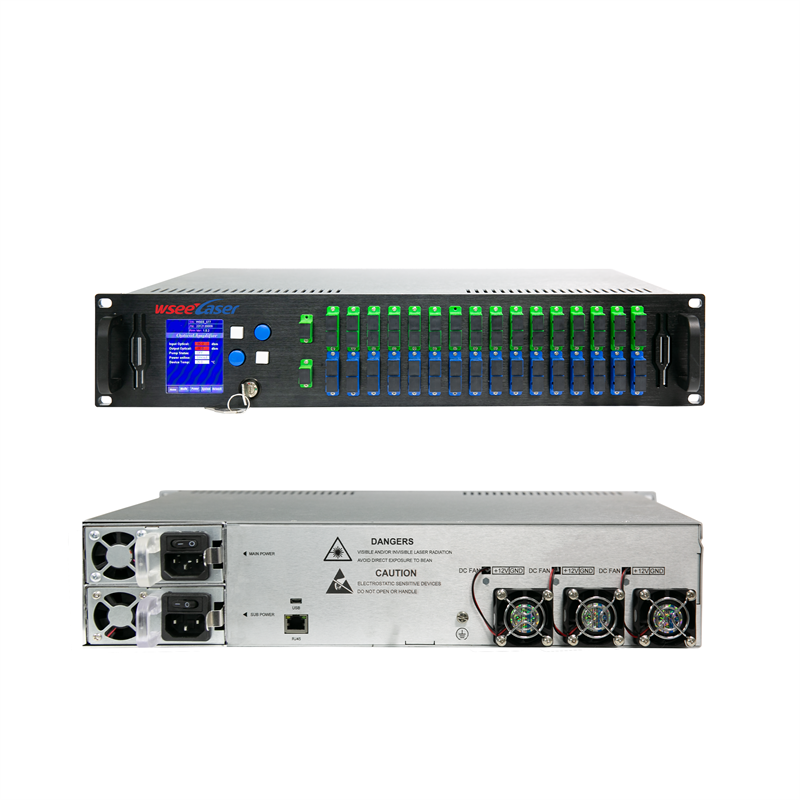
EDFA Working Principle: How Does It Work?
Understanding the EDFA working principle requires examining the physics of stimulated emission in erbium-doped fiber. The amplification process involves three key steps:
1. Pumping Excitation
A pump laser operating at either 980 nm or 1480 nm injects energy into the erbium-doped fiber. When pumped at 980 nm, erbium ions are excited from the ground state (⁴I₁₅/₂) to a higher energy state (⁴I₁₁/₂), from which they rapidly decay non-radiatively to a metastable state (⁴I₁₃/₂) with a long lifetime of approximately 10 milliseconds. This creates a population inversion, a critical condition for optical amplification.
2. Stimulated Emission
As the original 1550-nm-band signal photon propagates through the doped fiber, it triggers a stimulated emission process whereby one erbium ion is pumped from the excited state down to the ground state and emits one coherent photon of the same wavelength, phase and direction as the incoming signal photon. By doing this, the signal does not experience degradation and pure optical amplification is performed.
3. Pumping Configurations
There are three pumping configurations of EDFAs which can enable low noise operation, high output power or gain efficiency:
Co-directional Pumping: An in-line fiber amplifier pumped in the same direction as the signal, ensuring a low noise figure for a booster or pre-amplifier for the front of a communication link.
Counter-directional Pumping: This type of amplifier pumped in the opposite direction to the direction in which the signal is traveling is used for higher signal-to-noise-ratio devices
Bi-directional pumping: Combines both schemes for high gain, high power, and low noise ideal for long-haul trunk systems
Key Components of an EDFA
EDFA consists of following key modules:
Erbium-doped fiber (EDF): A segment of active fiber typically 10-100 m in length. It plays the primary role of gain medium through stimulated emission.
Pump laser diode: To provide excited light source to ionize ion to get higher state. Common Pump laser Diodes available include 980 nm and 1480 nm.
Wavelength-selective coupler: Used to combine signal light input and optical signal source to fiber (EDF). In an EDFA, these input lights coupled will be in C band for data transmission and pump is either in 1480 nm or 980 nm.
Optical isolator: Protect the EDFA gain performance and network signal from potential damage induced by reflective light back from subsequent network segments.
Gain flattening filter (GFF): It is used to compensate the inherent non-uniform fiber gain characteristic in a C-band, to flatten the overall transmission gain across all the channels transmitted.
EDFA Applications in Fiber Optic Networks
The EDFA has many useful applications in fiber-optic communication systems, including:
Long-haul terrestrial transmission: in-line optical amplifiers, used as repeaters of the trunk line, which compensates for fiber loss after tens of hundreds kilometers optical transport.
Submarine transmission system: It has played a significant role, ensuring reliable and stable transmission for thousands of kilometers across oceans.
Metropolitan WDM network transmission system: It is primarily used at the input of communication lines (pre-amplifier) or the end (booster) to increase signal strength to extend communication distances.
Optical fiber sensor: Applied to measure temperature, strain, etc of optical fiber on remote distance.
CATV and PON networks: EDFAs are essential components in cable television and passive optical network infrastructure, ensuring high-quality signal distribution.
Advantages of EDFA Technology
Compared with other technologies, the high performance optical EDFA has advantages:
High gain efficiency: gain of up to 20-40 dB is achieved over an efficient range of 100-200 km fiber lengths ;
Broad bandwidth: this device can simultaneously compensate for all the transmission windows so many wavelength channels could be achieved for transmission;
Low phase noise figure: The low phase noise and typical noise figures are in the order of 4 to 6dB which close to the quantum limited (3dB);
Bit rate independence: EDFAs amplify all data rates without modification, making them future-proof for network upgrades
Low crosstalk: The long upper-state lifetime of erbium ions suppresses inter-channel interference in WDM systems
Conclusion
Erbium Doped Fiber Amplifiers (EDFAs), the core optical amplifiers in the fiber optical transmission networks, effectively compensate for insertion losses in long distance optical links between the transmitting and receiving ends by all-optical signal amplification, ensuring a stable performance. In long haul backbone networks, submarine cable systems, WDM Metro networks etc, these EDFA applications play a crucial role.
Shandong Wanshuo Optoelectronic Equipment Co., Ltd. is a professional optical fiber amplifier manufacturing company. Our company provides comprehensive one-stop solutions of a complete supply chain for all optical communication fiber amplifiers including the production processes equipped with automatic production line, dust-free rooms and precise testing equipment. Our products have wide applications in long-haul trunking, submarine communications, metropolitan communications, PON networks, fiber sensing etc.