 EN
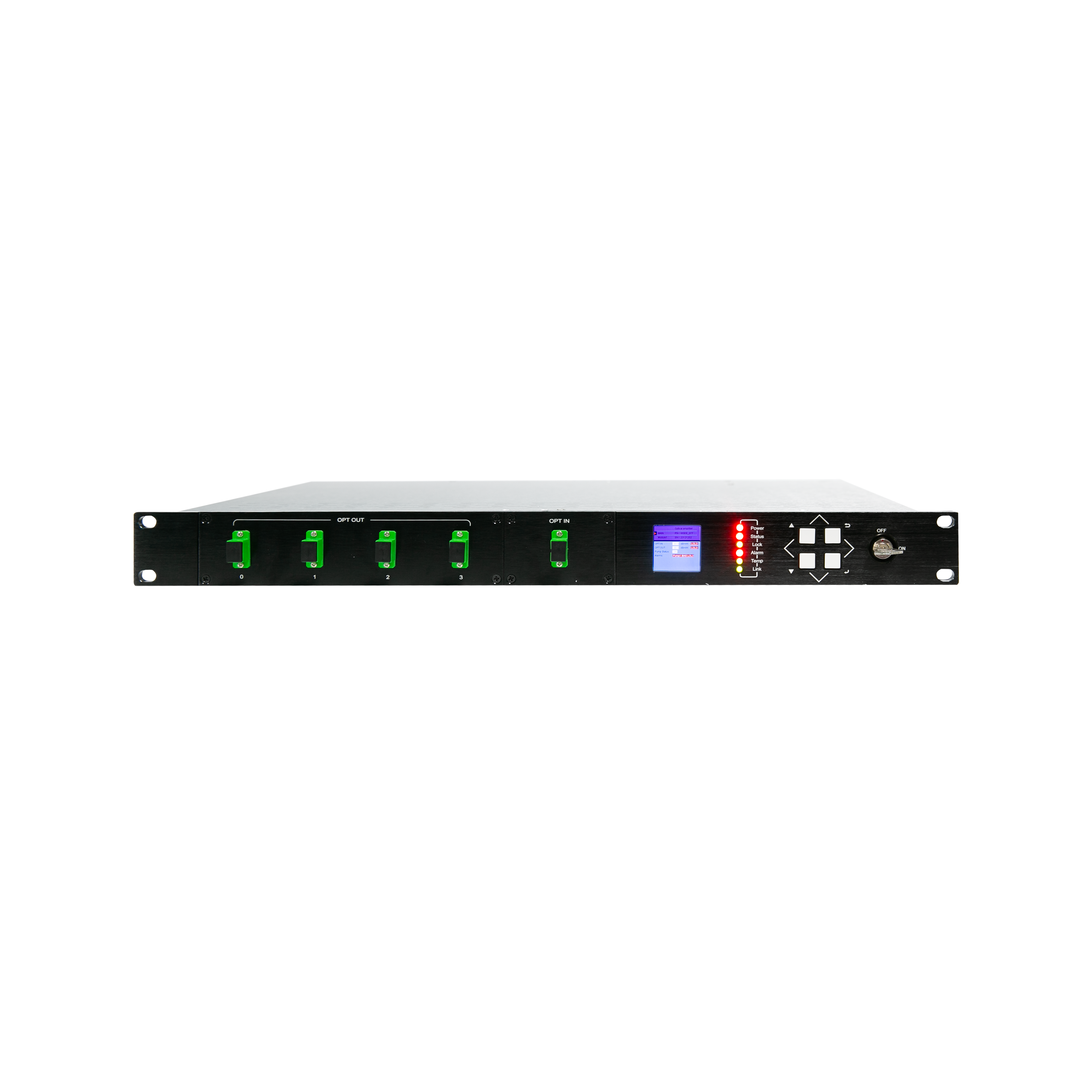
Amplification is emerging as a critical component in modern CATV all optical system networks. As optical signals travel long distances, they suffer from attenuation (the diminution of quality of an optical signal). The 1550 nm EDFA (Erbium-Doped Fiber Amplifier) has been a ubiquitous solution and industry standard for CATV network design by providing an exclusive set of attributes of performance, efficiency, and expandability.
Technical Superiority of 1550nm EDFA
The reason that EDFA 1550nm amplifiers can be deployed extensively in CATV network lies on basics of physics. Wavelength 1550nm falls into minimum loss window of conventional optical fiber and optimum gain window for Er doped fiber. The EDFA amplifier at 1550nm amplifier works by amplifying optical signal and has nothing to do with convert electrical signals to optical and vice versa, avoiding the O-E-O regeneration complexity/delay.
The mechanism for amplification is emission via stimulated emission. When the incoming 1550nm signal is propagated, these ions are excited from a pump laser (commonly 980 nm or 1480 nm) so there is population inversion. All the existing 1550 nm photons cause the excited ions to emit similar photons and therefore amplify the 1550 nm signal with no change of either wavelength or phase, gain can typically be up to 20-40 dB with very little noise, which is essential in achieving a good Carrier to Noise Ratio (CNR) for analog and digital CATV.
Enabling Large-Scale Network Architecture
CATV systems are typically a tree-and-branch systems, requiring a single headend to send signals to thousands of subscribers. If there were no amplification, optical signals would be lost before the first neighborhood nodes. To overcome this issue, a CATV optical amplifier such as the EDFA at 1550 nm can be used to restore signal strength at key stations, thus allowing coverage of 100 km or more.
Manufacturers such as Shandong Wanshuo Optoelectronic Equipment Co., Ltd. have been developing high power 1550 nm EDFA solutions based on Erbium-Ytterbium co-doped fiber technology for large-scale deployment. They can achieve total output power of 41 dBm, 64 or 128 ports with per-port output power ranging from 13 dBm to 23 dBm. This enables the use of a single optical source to support thousands of optical nodes thus providing the basis for economical CATV FTTH network growth.
Supporting Modern Convergence Services
The current-day CATV networks are becoming more and more integrated with data and voice services, also known as triple play integration. This evolution is achieved with a 1550 nm amplifier that can maintain transparent amplification of signals in any format. The EDFA amplifies uniformly, whether it carries analog television, digital QAM, or IP data, as long as the signal is on the correct wavelength.
The advanced EDFA system has an embedded WDM module allowing PON data wavelengths (1310 nm and 1490 nm) to be multiplexed with CATV signals (1550 nm) into a single fiber. This facilitates the delivery of broadcast video services to customers at a lower cost of deployment without requiring operators to deploy extra infrastructure when delivering broadband Internet and voice services.
Reliability and Intelligent Management
Today's 1550 nm EDFA platforms are built with extensive reliability features that are essential to carrier class CATV services. The most prominent manufacturers equip their products with redundant, hot switchable power supplies, automatic temperature control (ATC) and automatic power control (APC) circuits in their EDFA 1550 nm products to provide stable output of ±0.1dB. Sophisticated management interfaces such as Web, SNMP, RS-232 and RS-485 allow for remote monitoring, configuration, and fault diagnosis.
For instance, Shandong Wanshuo Optoelectronic Equipment Co., Ltd. has made large investments in the automated production line, such as the high-speed SMT line that is directly connected with 3D SPI and AOI inspection—achieving a first-pass yield of 99.8%. This manufacturing accuracy guarantees the quality required for 24/7 operation in mission critical CATV networks, ensuring stability and performance.
Conclusion
The 1550nm EDFA has emerged as the choice of CATV optical amplifier because of its ability to capitalize on the fiber optics physics, cost-effective large-scale distribution and converged service delivery. The 1550nm EDFA is the key technology driving this evolution as CATV networks move towards higher capacity and wider coverage.